La tipocosmia di Alessandro Citolini
La tipocosmia di Alessandro Citolini | Libri antichi e moderni | CITOLINI, Alessandro (1500-1582)



La tipocosmia di Alessandro Citolini
La tipocosmia di Alessandro Citolini | Libri antichi e moderni | CITOLINI, Alessandro (1500-1582)
Metodi di Pagamento
- PayPal
- Carta di Credito
- Bonifico Bancario
- Pubblica amministrazione
- Carta del Docente
Dettagli
- Anno di pubblicazione
- 1561
- Luogo di stampa
- Venezia
- Autore
- CITOLINI, Alessandro (1500-1582)
- Editori
- Vincenzo Valgrisi
- Soggetto
- Quattro-Cinquecento
- Stato di conservazione
- Buono
- Lingue
- Italiano
- Legatura
- Rilegato
- Condizioni
- Usato
Descrizione
ART OF MEMORY
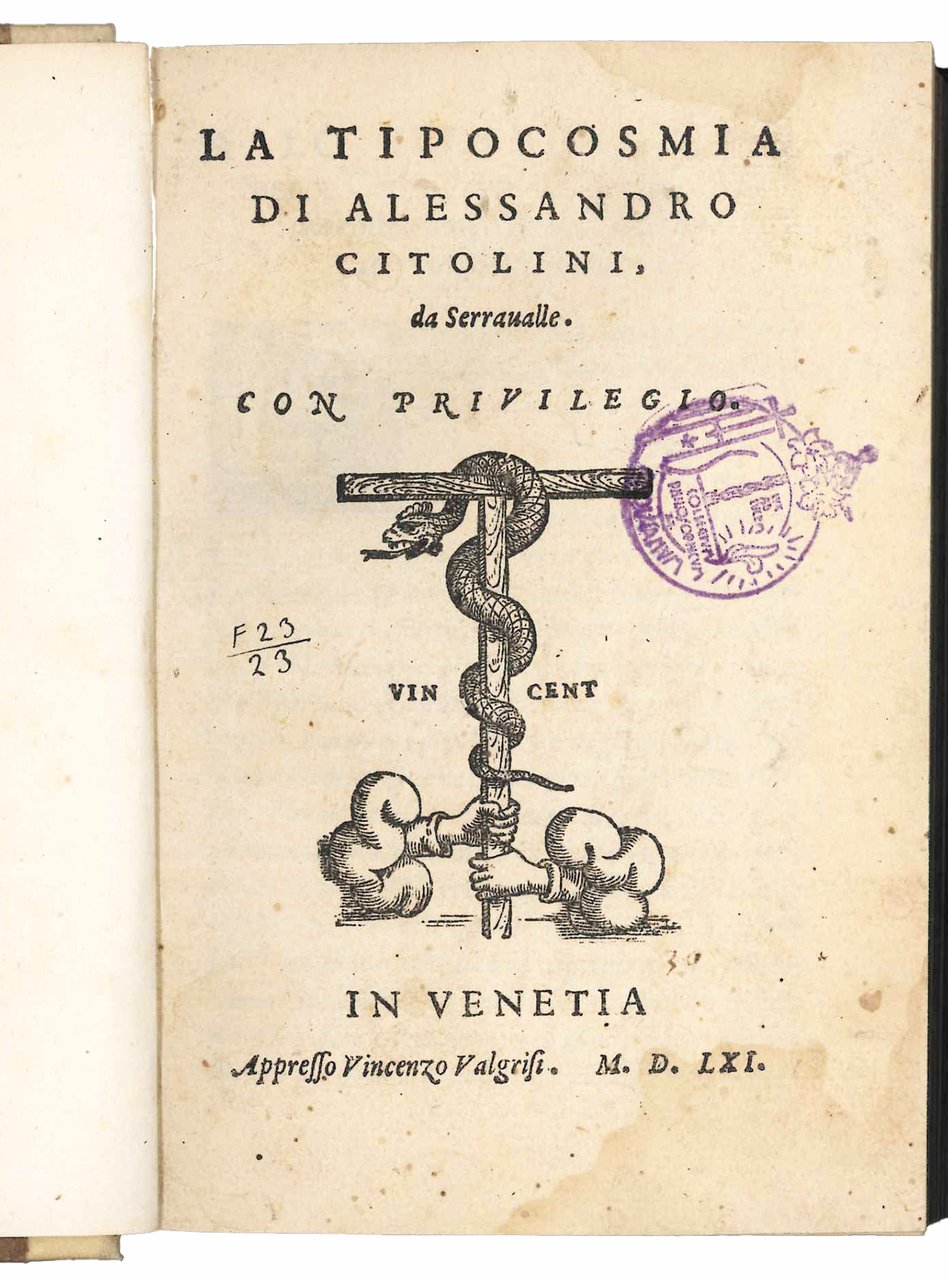
8vo (149x98 mm). [16], 552 pp. Collation: *8 A-Ll8 Mm4. Leaf *8 is a blank. Woodcut printer's device on the title page. Italic and roman types. Woodcut initials. 19th-century quarter vellum, red morocco lettering piece on spine. Stamp on the title page. Some occasional light foxing, a good copy.
First edition, dedicated to Carlo Perrenot, Bishop of Arras, of the Tipocosmia, a sort of encyclopedia of all the liberal arts or a treatise on the sciences, arts, and crafts, and, at the same time, a manual on the art of memory. This is Alessandro Citolini's magnum opus, which he claims to have completed ten years earlier but decided to print only now, after a long illness that, with the risk of losing his life, had made him fear that the fruit of his arduous research might be lost.
The work is structured as a dialogue unfolding over seven days, modeled on the creation of the world, which is entirely consistent with the approach the author adopted in organizing and presenting the body of knowledge. Without claiming to be exhaustive, this model allowed each reader to construct a similar one for themselves and closely followed the framework already outlined in a previous shorter work, the Luoghi (Venice, 1541), enriching it with new details and, above all, supplementing it with a very long list of names, objects, plants, stones, islands, rivers, cities, sciences, trades, and so on, in which the desire for an encyclopedic classification of knowledge ultimately took the form of a sort of endless lexical enumeration. This explains the definition of “vocabulary” (“vocabulorum artis cuiusque massa et acervus,” as Bacon put it in De dignitate et augmentis scientiarum, VI, 2, Paris, 1624, p. 320), which has often been attributed to the Tipocosmia, whose essential purpose, in the author's view, remained that of offering a model for the organic structuring of knowledge for mnemonic and rhetorical purposes. The connection between this work by Citolini and the research that was central to the work of his teacher Giulio Camillo, author of the well-known Idea del theatro, is evident. The issue of the relationship between the model developed by Citolini and Camillo's studies is, however, complex, particularly in light of the accusations of plagiarism that were leveled in the past against the author of the Tipocosmia. In reality, Citolini's research operates from a partially independent perspective, especially regarding the symbolic, hermetic, kabbalistic, and magical aspects that constitute an essential element of Giulio Camillo's work.
The Tipocosmia is thus presented in the form of a dialogue set in a quiet, cool, and pleasant place, far from the city and accessible only by boat -essentially a sort of locus amoenus- and features as its interlocutors Count Collaltino di Collalto (a figure associated with Pietro Aretino's Venetian cultural circle, to whom much of the argument is entrusted), Domenico Venier (a friend of Federico Badoer, who in 1557 inspired the ambitious encyclopedic project conceived by the Accademia della Fama), Girolamo Ferro, Count Gian Jacopo Leonardi (ambassador of the Duke of Urbino to Venice until 1553), and Count Muzio di Porcia (brother-in-law of Isabella Frattina, to whom Citolini had given Latin lessons between 1553 and 1554 at the home of his mother, Caterina Sauli). On the second day, other figures join them, such as Agostino Malipiero, Alessandro Leoni, Valerio Marcellino, Giulio Rangoni, and Ottonello Pasini; between the third and fourth days, Marcantonio Giustiniani and Piero Coco finally join the group. On the seventh and final day, the participants gather to take stock of the previous days at the home of the Count of Collalto, who, with the utmost courtesy, receives his guests in his garden.
Compared to Camillo's wooden theater or the visual encyclopedism of the Accademia della Fama, Citolini offers a different technique of memory based on words rather than images. Although the Tipocosmia appears to sh