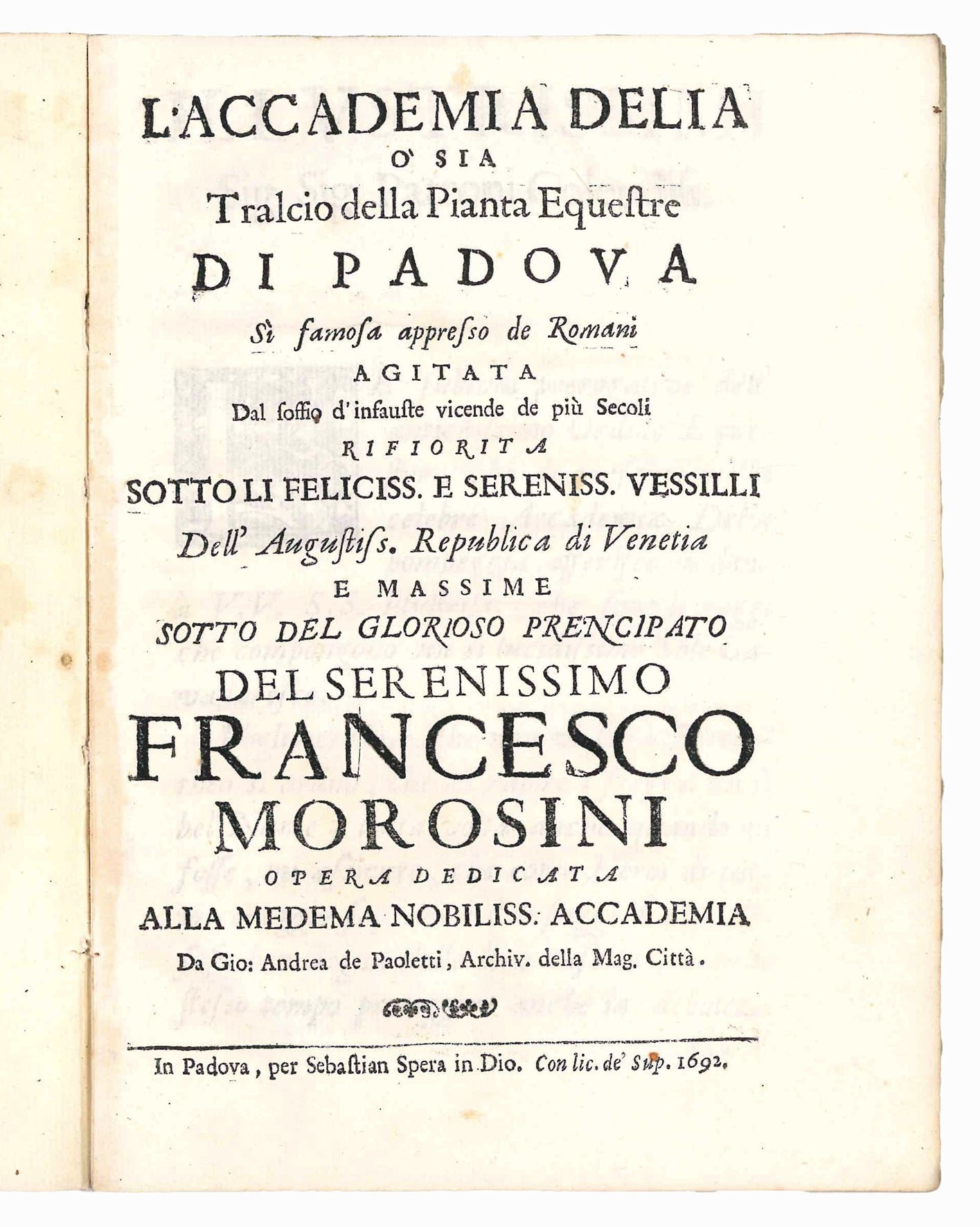
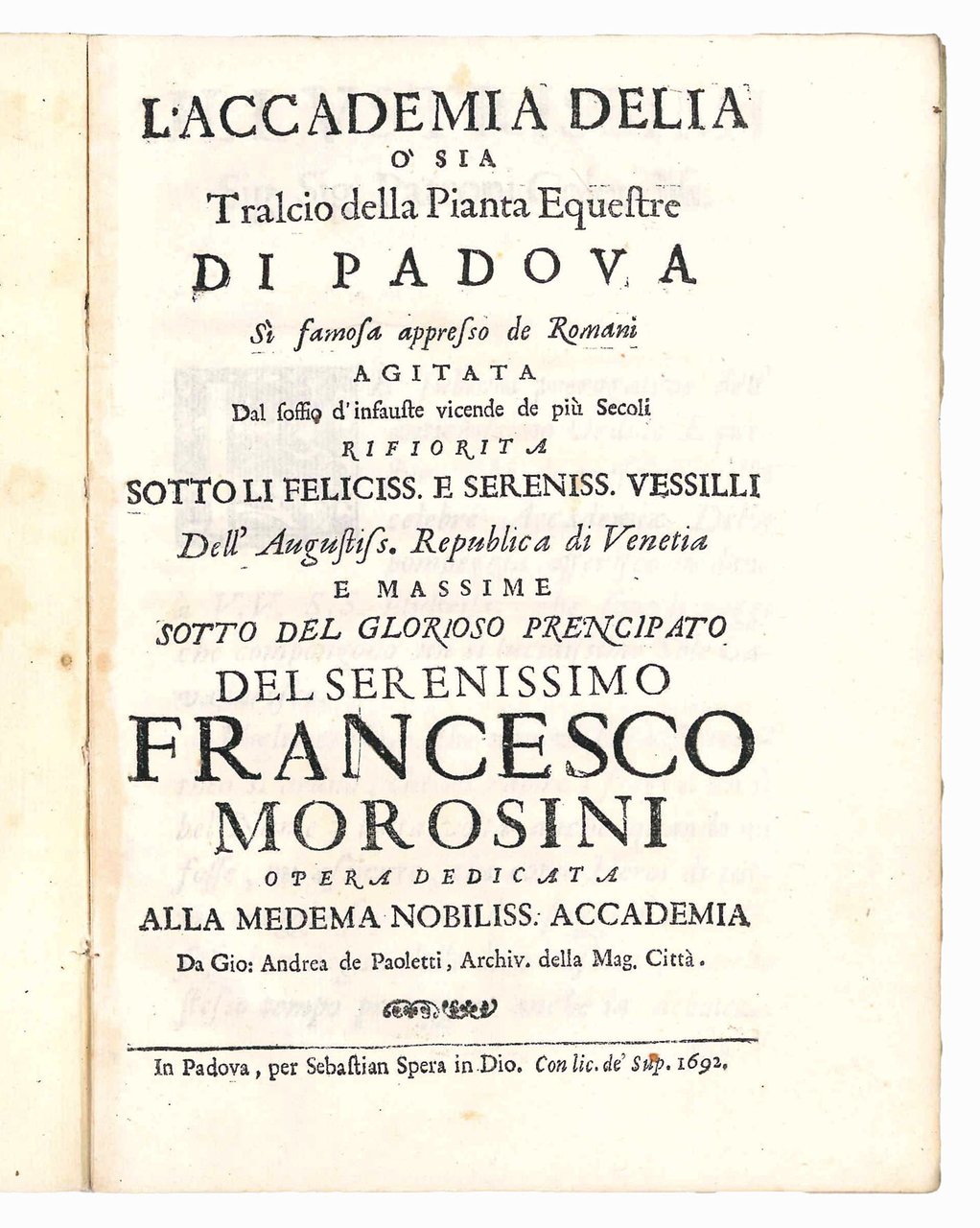
L'Accademia Delia o sia Tralcio della pianta equestre di Padova si famosa appresso de Romani agitata dal soffio d'infauste vicende de più secoli rifiorita sotto li Feliciss. e Sereniss. Vessilli dell'Augustiss. Republica di Venetia e massime sotto del Glorioso Prencipato del Serenissimo Francesco Morosini opera dedicata alla medema Nobiliss. Accademia da Gio. Andrea de Paoletti Archiv. della Mag. Città
L'Accademia Delia o sia Tralcio della pianta equestre di Padova si famosa appresso de Romani agitata dal soffio d'infauste vicende de più secoli rifiorita sotto li Feliciss. e Sereniss. Vessilli dell'Augustiss. Republica di Venetia e massime sotto del Glorioso Prencipato del Serenissimo Francesco Morosini opera dedicata alla medema Nobiliss. Accademia da Gio. Andrea de Paoletti Archiv. della Mag. Città | Libri antichi e moderni | PAOLETTI, Giovanni Andrea (fl. 17th-18th cent.)
L'Accademia Delia o sia Tralcio della pianta equestre di Padova si famosa appresso de Romani agitata dal soffio d'infauste vicende de più secoli rifiorita sotto li Feliciss. e Sereniss. Vessilli dell'Augustiss. Republica di Venetia e massime sotto del Glorioso Prencipato del Serenissimo Francesco Morosini opera dedicata alla medema Nobiliss. Accademia da Gio. Andrea de Paoletti Archiv. della Mag. Città
L'Accademia Delia o sia Tralcio della pianta equestre di Padova si famosa appresso de Romani agitata dal soffio d'infauste vicende de più secoli rifiorita sotto li Feliciss. e Sereniss. Vessilli dell'Augustiss. Republica di Venetia e massime sotto del Glorioso Prencipato del Serenissimo Francesco Morosini opera dedicata alla medema Nobiliss. Accademia da Gio. Andrea de Paoletti Archiv. della Mag. Città | Libri antichi e moderni | PAOLETTI, Giovanni Andrea (fl. 17th-18th cent.)
Metodi di Pagamento
- PayPal
- Carta di Credito
- Bonifico Bancario
- Pubblica amministrazione
- Carta del Docente
Dettagli
- Anno di pubblicazione
- 1692
- Luogo di stampa
- Padova
- Autore
- PAOLETTI, Giovanni Andrea (fl. 17th-18th cent.)
- Editori
- Sebastiano Sperandio
- Soggetto
- seicento
- Stato di conservazione
- Buono
- Lingue
- Italiano
- Legatura
- Rilegato
- Condizioni
- Usato
Descrizione
ACCADEMIA DELIA OF PADUA
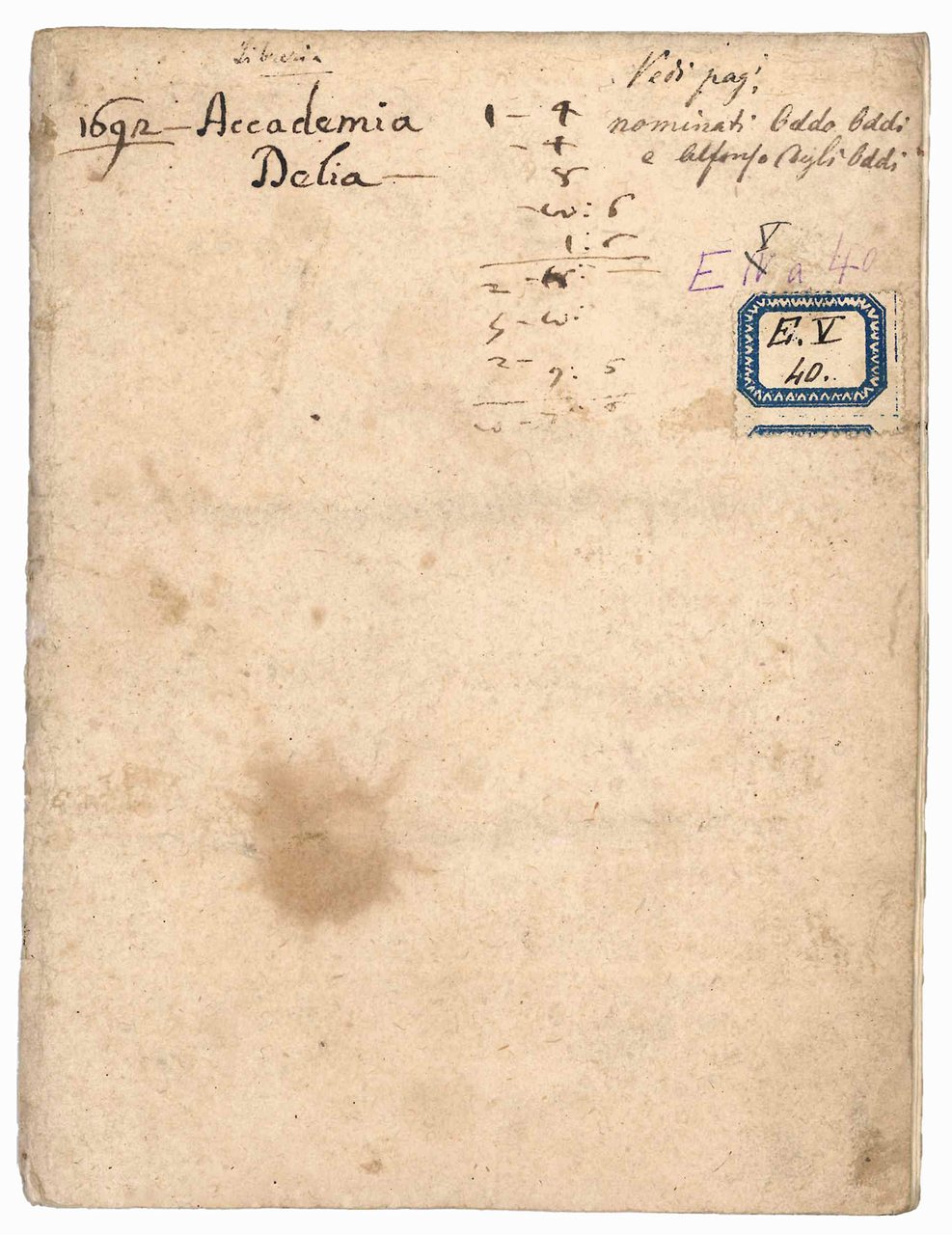
4to (190x140 mm). [4], 22, [2] pp. Collation: [π]2 A-C4. Contemporary cardboards, inked title on the front panel. On the front fly-leaf later armorial bookplate with the initials “AR” and the motto “Semper idem”. A very good, genuine copy.
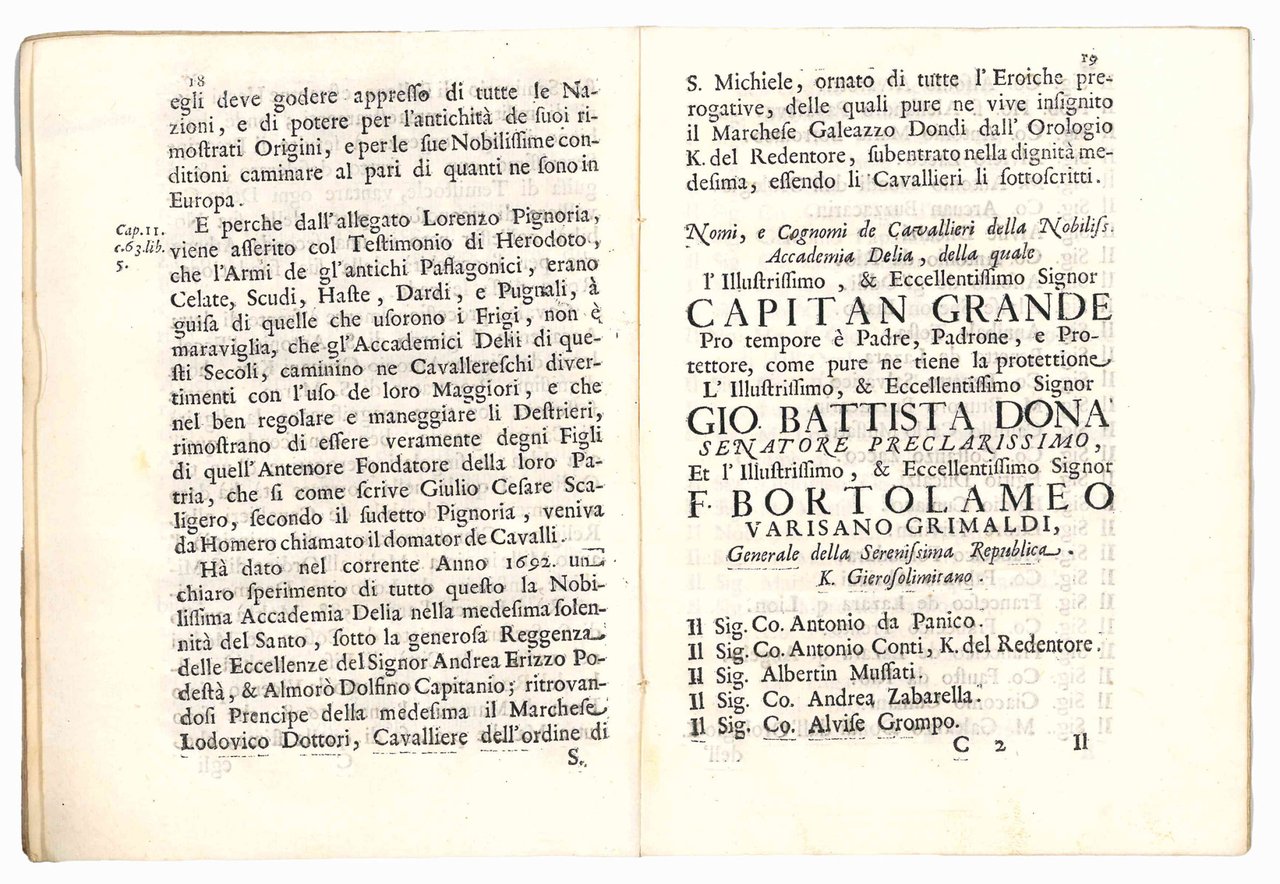
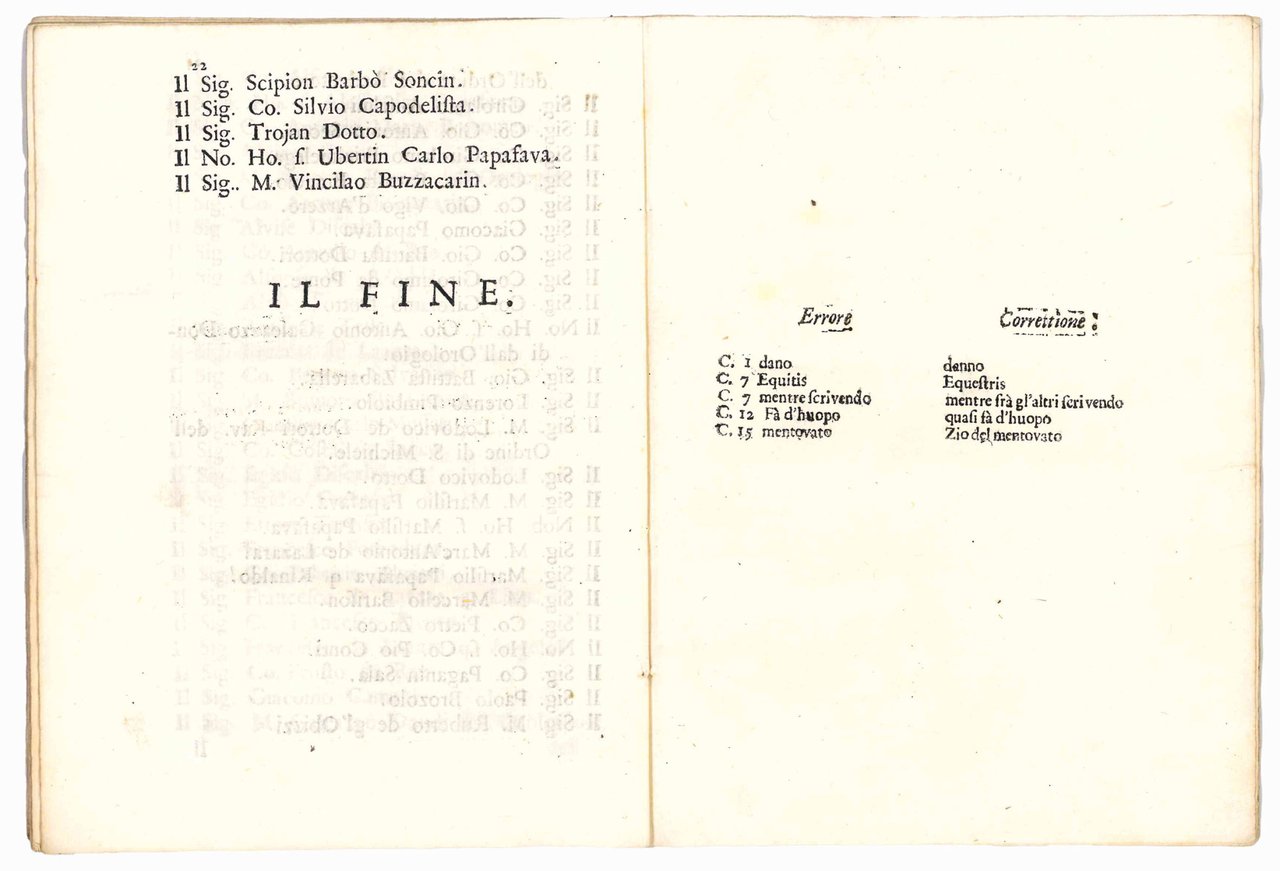
Extremely rare first edition. The author of the pamphlet, Giovanni Andrea Paoletti, who was the city of Padua's archivist at the time, supports the Paduan patricians' claim that the Delia academy should be recognized as an “equestrian order”. A list of all the knights who were members of the academy is included at the end of the pamphlet. The academy at the time had over sixty members.
The Accademia Delia was an equestrian academy founded on March 12, 1608. It was established by the Venetian patrician Pietro Duodo (1554-1610), who was an ambassador and an expert in military affairs and architecture. At the time of its founding, Duodo was also captain of Padua. The academy's purpose was to train young men in the arts of horsemanship and warfare. Located in the old citadel opposite the Torlonga, later known as the Specola, the academy overlooked the Bacchiglione from the site of today's Piazza Accademia Delia. The building was almost completely destroyed by a fire in 1798. The academy's leadership included a prince, four councilors, a mayor, and a contradictor. These positions were renewed every four months. From its inception, Galileo Galilei, a personal friend of Duodo, played a significant role. He drafted a specific curriculum titled Raccolta di quelle cognizioni che à perfetto cavaliero et soldato si richieggono, le quali hanno dependenza dalle scienze matematiche (1609) and, in the same year, taught a course on military architecture at the city's university. In addition to fencing and horsemanship, the Academy taught subjects such as Euclidean geometry, mechanics, mathematics, and the study of fortifications and military strategies. The academy also regularly organized performances, jousts, and knightly tournaments. The inability to cover ever-increasing expenses, arising from the organization's needs and the staging of public performances, led to a general loss of enthusiasm and the academy's closure in 1801 (cf. G. Oreffice, L'Accademia Delia di Padova, in: “Memorie dell'Accademia patavina di Scienze Lettere e arti, Classe di scienze morali, lettere ed arti”, 78, 1965/66, pp. 241-294; and A. Gheller, L'Accademia Delia, dove Galileo fu bocciato, in: “La scienza nascosta nei luoghi di Padova”, Padua, 2019, pp. 120-127).
Italian Union Catalogue, IT\ICCU\PUVE\029162.