De functionibus arbitrariis calculi integralis. Dissertatio.
De functionibus arbitrariis calculi integralis. Dissertatio. | Libri antichi e moderni | LORGNA, Antonio Mario (1730-1796)
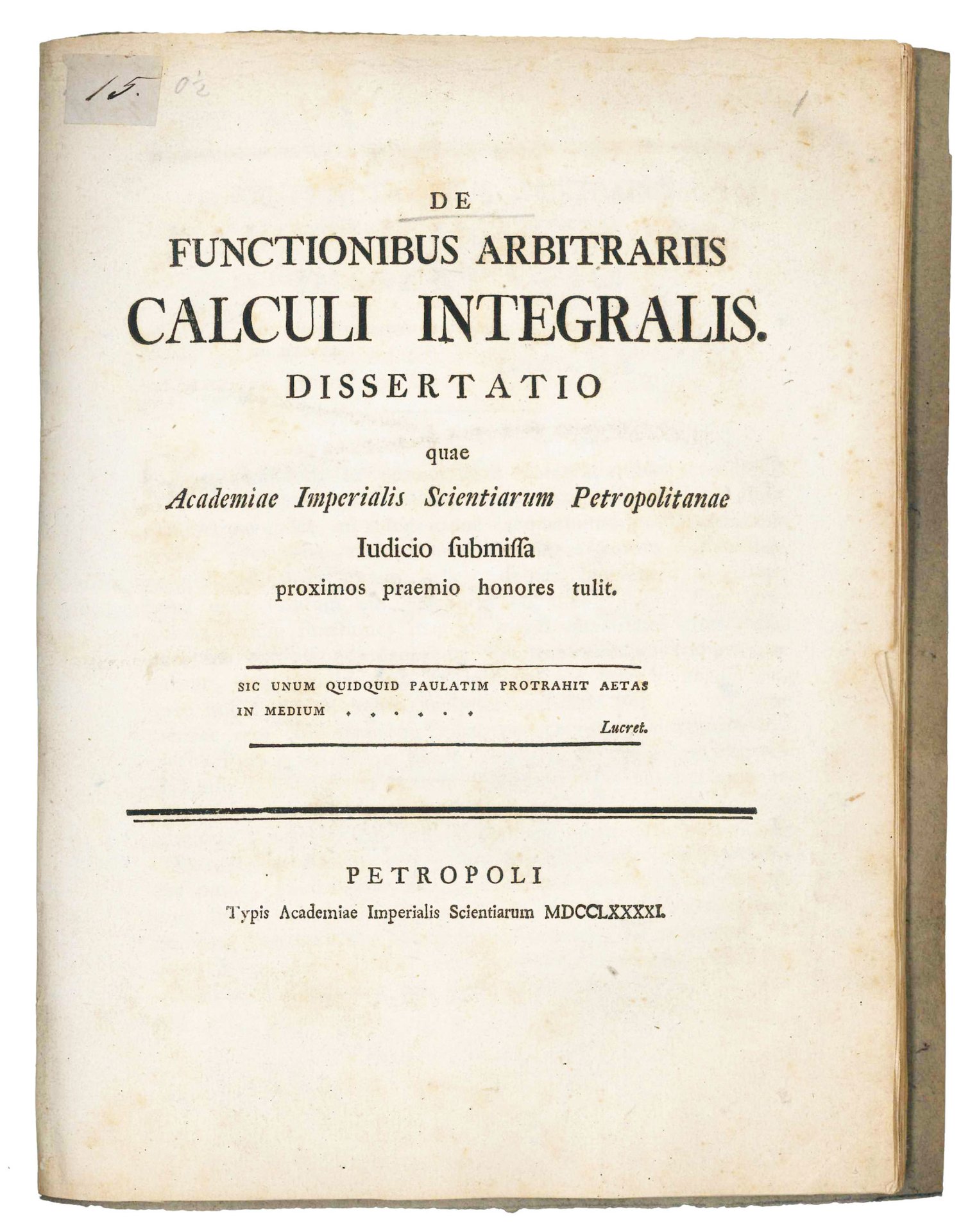
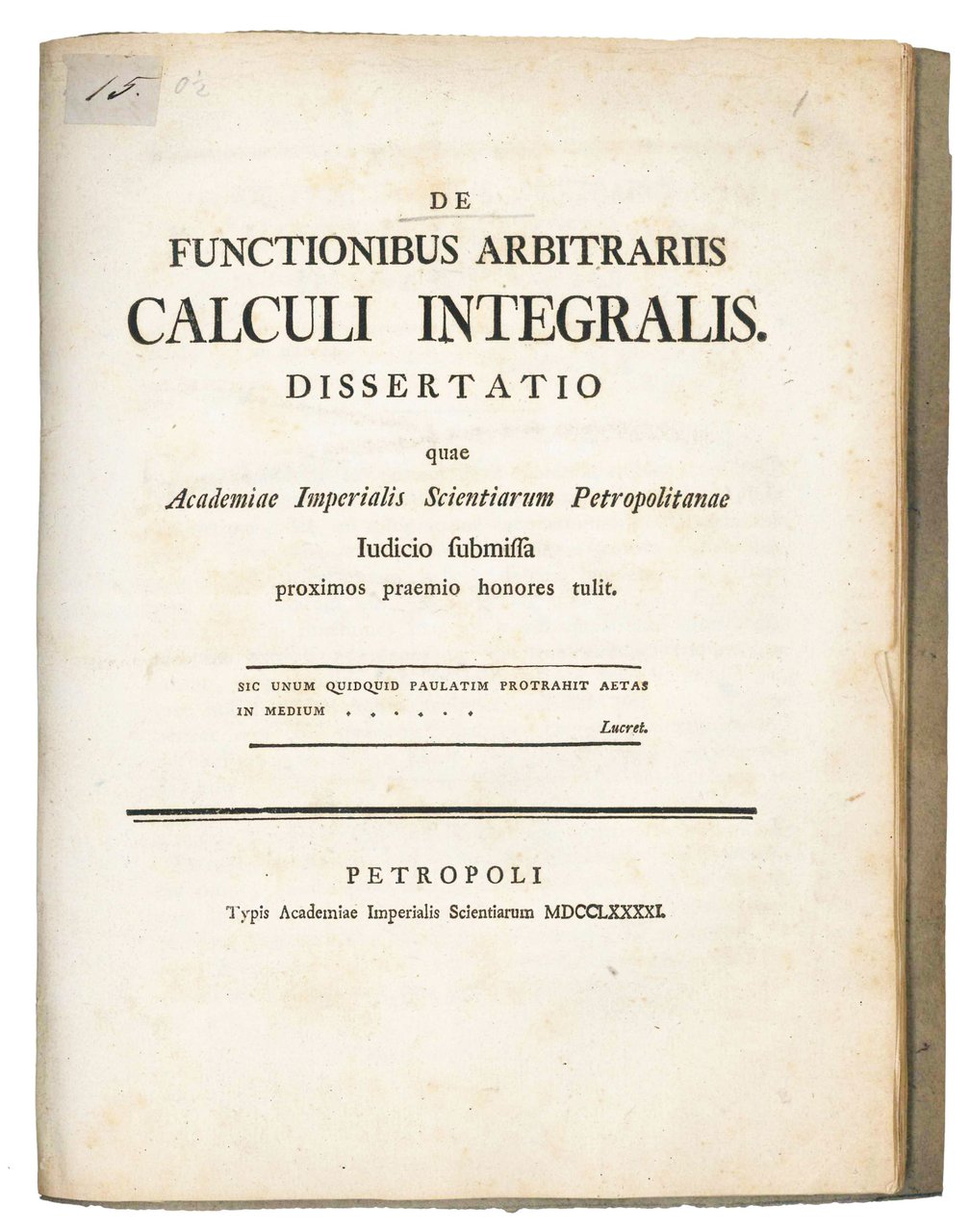

De functionibus arbitrariis calculi integralis. Dissertatio.
De functionibus arbitrariis calculi integralis. Dissertatio. | Libri antichi e moderni | LORGNA, Antonio Mario (1730-1796)
Metodi di Pagamento
- PayPal
- Carta di Credito
- Bonifico Bancario
- Pubblica amministrazione
- Carta del Docente
Dettagli
- Anno di pubblicazione
- 1791
- Luogo di stampa
- Saint Petersburg
- Autore
- LORGNA, Antonio Mario (1730-1796)
- Editori
- Typis Academiae Imperialis Scientiarum
- Soggetto
- settecento
- Stato di conservazione
- Buono
- Lingue
- Italiano
- Legatura
- Rilegato
- Condizioni
- Usato
Descrizione
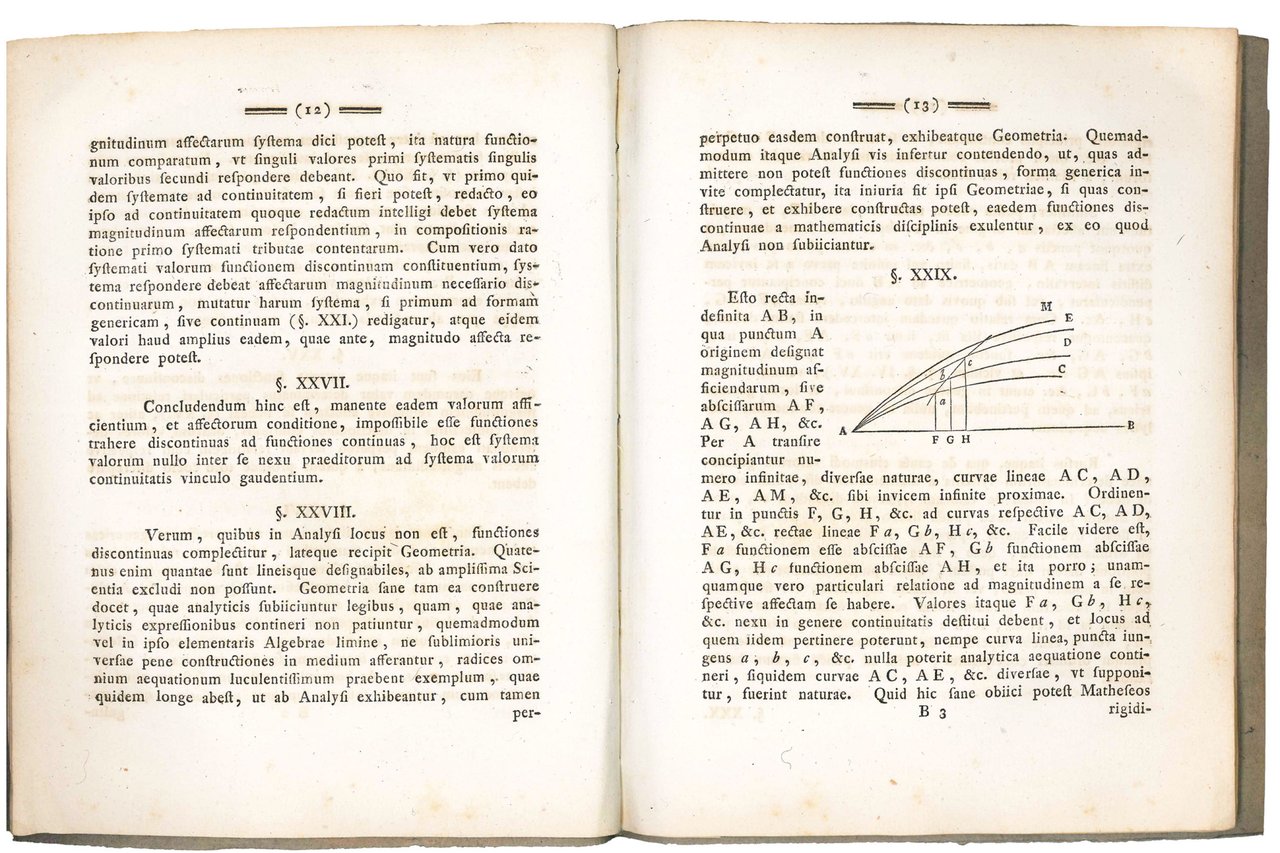
4to (244 x 185 mm). 28 pages. Collation: A-C⁴ D². Modern wrappers. Copy lightly browned and stained, but overall a good exemplar. Written in latin.
First edition. The following treatise was written by Lorgna following the first announcement of the St. Petersburg Academy's competition for the resolution of arbitrary functions, in 1779. As we read on the title page, it was indeed submitted to the Russian Academy for judgment and received the honors closest to first prize. It is sometimes bound with the treatise by the French mathematician Arbogast, entitled Mémoire sur la nature des fonctions arbitraires qui entrent dans les intégrales des équations aux différentielles partielles and published in St. Petersburg: he participated and won the second call for the competition in 1787. Benefiting also from the discussions born from the previous essays (including that of Lorgna), he went a step further: in his treatise in French he proposed a formal classification of the various types of functions (continuous, discontinuous, geometric) and introduced the concept of "discontinuous" functions in the modern sense (functions composed of pieces of different curves), effectively resolving the philosophical-mathematical dispute and overcoming the limitations of his predecessors.
Antonio Maria Lorgna was one of the most brilliant and influential Italian mathematicians, military engineers, and scientific organizers of the late Enlightenment. Born in Verona, he received a rigorous education that combined classical humanities with advanced mathematical sciences, leading him to enter the prestigious Military Corps of the Republic of Venice. He quickly distinguished himself both on the battlefield and in the classroom, eventually rising to the rank of Colonel and becoming the Governor and Director of Studies at the Military Academy of Verona. As a military engineer, he directed major fortifications, territorial surveys, and hydraulic infrastructure projects across the Venetian mainland, establishing himself as a leading authority on water management, canalization, and civil defense. Beyond his technical achievements in engineering, Lorgna left an indelible mark on the international scientific community through his pure mathematical research and institutional leadership. His theoretical work focused primarily on mathematical analysis, infinite series, and advanced calculus, earning him widespread recognition and corresponding memberships in the most elite academies of Europe, including the Royal Society of London and the Imperial Academy of Sciences in St. Petersburg. However, his greatest historical legacy is undoubtedly the foundation, in 1782, of the Società Italiana delle Scienze (initially known as the Società dei Quaranta and today as the Accademia dei XL). Distressed by the political fragmentation of the Italian peninsula, Lorgna single-handedly united the forty most illustrious Italian scientists of the era, including Alessandro Volta, Lazzaro Spallanzani, and Joseph-Louis Lagrange, under a single, national scientific body that transcended regional borders, effectively making him a foundational pioneer of Italian intellectual unification.
OCLC, 927046796; DSB I, pages 206-208. Dizionario Biografico degli Italiani, Trecccani, Volume 66 (2006).