Beginnings of Opera in Europe. Origins, Adaptations, and Cultural Exchange
Beginnings of Opera in Europe. Origins, Adaptations, and Cultural Exchange | Libri antichi e moderni | Nastasia Heckendorff, Michael Klaper (Eds)
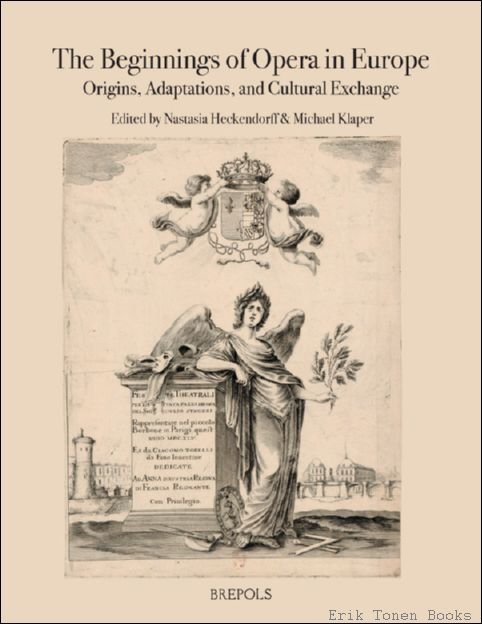
Beginnings of Opera in Europe. Origins, Adaptations, and Cultural Exchange
Beginnings of Opera in Europe. Origins, Adaptations, and Cultural Exchange | Libri antichi e moderni | Nastasia Heckendorff, Michael Klaper (Eds)
Metodi di Pagamento
- PayPal
- Carta di Credito
- Bonifico Bancario
- Pubblica amministrazione
- Carta del Docente
Dettagli
- Autore
- Nastasia Heckendorff, Michael Klaper (Eds)
- Editori
- , Brepols, 2026
- Soggetto
- Muziek, Music, Musique, Music
Descrizione
Paperback, Pages: 337, Size:216 x 280 mm, Illustrations:2 b/w, 12 col., 7 tables b/w., 2 tables col., 1 musical example, Languages:English, German, Italian. ISBN 9782503583648. Summary This is the first book dedicated to the early history of opera in Europe from a comparative perspective. It takes into account not only the various beginnings of opera in Italy around 1600 (Florence, Rome, Mantua), but also the mechanisms of reception and adaptation of the new genre outside of Italy in the following decades (in the German-speaking realm, and in the Commonwealth of Poland and Lithuania). Questions of genre and its terminology are discussed as well as the history, function, and contents of librettos and their distinctive linguistic and structural devices. Special attention is paid to issues of performance practice, such as the assignation of certain types of roles to certain types of singers, and staging. In order to broaden this perspective, the influence of Spanish 17th-century spoken drama on the early Venetian opera is explored. Furthermore, the beginnings of regional operatic traditions outside of Italy (such as in Spain and France) play a central role, along with the specifically English concept of 'dramatic opera', and the question of music in spoken drama. In this way, new and fascinating insights can be gained into opera in its initial phase (roughly from 1600 to 1680), including its development and regional styles, its acceptance or rejection, and the critical discourse surrounding the genre. TABLE OF CONTENTS Introduction Nastasia Heckendorff/Michael Klaper Prologue: Encountering Opera Margaret Murata 1. The Libretto Funzioni e ruolo del libretto Paolo Fabbri Argomenti als Schwellentexte in italienischen Libretti des 17. Jahrhunderts Albert Gier 2. The Beginnings of Opera in Italy 'Fa' riflesso al mio discorso': 'Singing' and 'Speaking' in Monteverdi's Operas Tim Carter Knabens nger in der fr hen r mischen Oper - Aspekte der Gattungsgeschichte und Auff hrungspraxis Nastasia Heckendorff 'Un contralto per fare una vecchia': Representations of the 'Old Woman' in Early Venetian Opera Michael Klaper 3. Reception, Adaptation, and Regional Traditions Outside of Italy The Earliest Adaptations of Italian Musical Drama in Salzburg, Prague, Vienna, and Innsbruck Herbert Seifert Ladislaus Sigismund Vasa (1595?1648) and the Beginnings of Opera in the Commonwealth of Poland and Lithuania Barbara Przybyszewska-Jarmi?ska Sch tz, Opitz und die Dafne (1627) - Die fr he Entwicklung des dramma per musica in Italien und im deutschsprachigen Raum im Vergleich Hanna Vieh fer-J rgens The Work of Opera in the Spanish Dominions Louise Stein Vocalit la fran aise, du ballet de cour l'op ra Catherine Massip Speaking Mortals and Singing Spirits: Concepts and Practice of English Dramatic Opera in the Seventeenth Century Martin Adams 4. Opera and Other Literary Genres Music in Early Modern Drama Irmgard Scheitler Platani e regine (I): The Roots of Dramatic Structure in Nicol Minato and Francesco Cavalli's Persian Cycle (1655?59) Sara Elisa Stangalino Platani e regine (II): Nicol Minato and Francesco Cavalli's Persian Cycle (1655?59) - The Roots of a New Aesthetics of Aria Hendrik Schulze