Wanderstudent 2000. The Wanderstudent of 1425 revived in virtual reality in 2000? Towards a European Virtual University. Proceedings of the International Colloquium, organised by EuroPACE in the framework of the 575th anniversary celebrations of the Katholieke Univers.
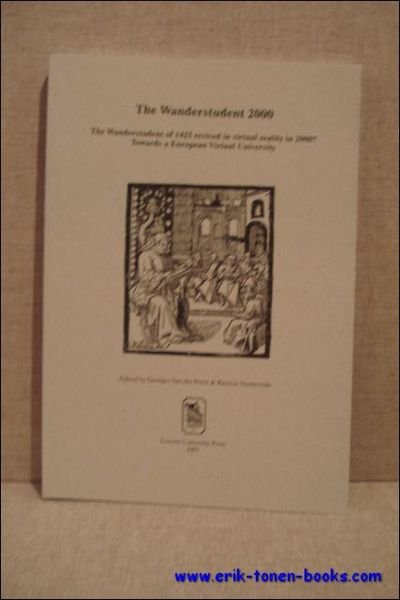
Wanderstudent 2000. The Wanderstudent of 1425 revived in virtual reality in 2000? Towards a European Virtual University. Proceedings of the International Colloquium, organised by EuroPACE in the framework of the 575th anniversary celebrations of the Katholieke Univers.
Metodi di Pagamento
- PayPal
- Carta di Credito
- Bonifico Bancario
- Pubblica amministrazione
- Carta del Docente
Dettagli
- Autore
- Van Der Perre, Georges And Vandevelde, Patricia.
- Editori
- Leuven, Universitaire Pers, 2001
- Soggetto
- Universitaire Pers Leuven, Universitaire Pers, Universitaire Pers, Universitaire Pers
Descrizione
Paperback, English, original editor's jacket, 16x24 cm., 172 pp. ISBN 9789058671561. 'The Wanderstudent of 1425 revived in virtual reality in 2000!' This was the leading theme of the 'Wanderstudent 2000' conference held in Leuven (Belgium) in October 2000, in the framework of the 575th anniversary of the Katholieke Universiteit Leuven. Just as during the middle ages German students wandered over the country to visit the best masters and to gather knowledge and credits from them, should we not expect students of the third millenium to do the same, but now 'virtually' and 'globally'? Will this virtual wandering be left completely to the free initiative of the individual student? Will universities encourage it and create supporting structures? Will universities control and structure the process by establishing inter-university networks and creating joint virtual campuses? Will universities join efforts with industry and society to create flexible lifelong learning systems? Whereas on the one hand ICT-based networking between universities clearly offers a huge potential for the enrichment of learning contents, for the stimulation of international exchanges and mobility, and for the enhancement of flexibility and accessibility, on the other hand a number of logistical problems have to be solved, related to assurance of educational quality, acrreditiation and credit transfer, intellectual property rights, languages and cultural differences, cost efficiency,equality of access for all sections of society across continents.These challenging questions gave sufficient food for thought and discussion to the 170 participants from 21 different countries, who effectively used this conference as an appropriate forum for exchanging points of view on the concept and implementation of a 'distributed virtual university' in all its aspects.
